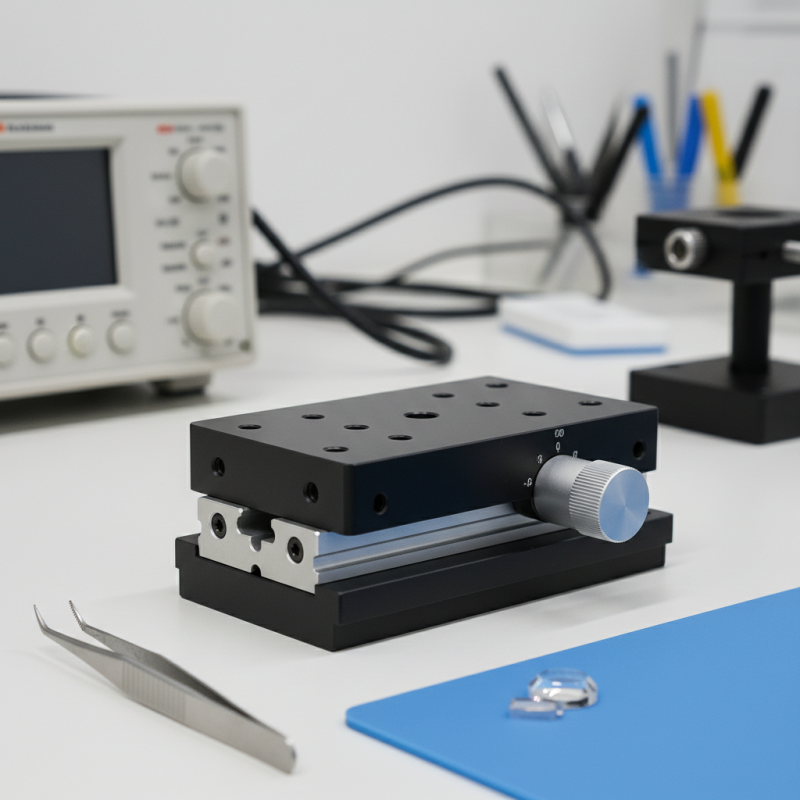
What is a Manual Linear Stage and How Does it Work?
In the world of precision engineering, the Manual Linear Stage stands out for its simple yet effective design. According to Dr. Emily Carter, a leading expert in motion systems, "A Manual Linear Stage offers unparalleled control in various applications." This reflects its importance in industries requiring exact positioning.
A Manual Linear Stage allows users to adjust positions manually, providing flexibility. Many engineers rely on it for experimentation and precise setups. The device can be an essential tool, but its performance can be limited by operator skill. Users must focus on technique to achieve accuracy.
Although these stages are effective, human error can lead to inconsistencies. Attention to detail is crucial. Proper calibration and methodical adjustments can enhance outcomes. The Manual Linear Stage truly embodies the blend of simplicity and expertise in engineering.
What is a Manual Linear Stage and Its Purpose in Precision Movement
A manual linear stage is a precision instrument used for controlled movement along a single axis. It allows the user to position objects with remarkable accuracy. These stages are essential in various fields, such as optics, microscopy, and manufacturing. The primary purpose is to provide fine adjustments for alignment or positioning. Users often require repeated movements, and manual stages serve this need efficiently.
Operating a manual linear stage may seem straightforward. However, achieving the desired precision can be challenging. Users must have a steady hand and a keen eye for alignment. Sometimes, users might feel frustrated when results are not as expected. This imperfection often happens due to slight miscalculations or unnoticed tilts. Understanding these challenges can enhance user skill and improve outcomes.
The design typically includes a handle for easy manipulation, enabling gradual adjustments. Some stages feature graduated scales for reference, aiding in repeatability. Users often appreciate the tactile feedback during operation, allowing for subtle movements. Yet, occasionally, these mechanical systems require maintenance to function smoothly. Dust and wear can impact precision over time and may warrant reflection on best practices for care.
Manual Linear Stage Specifications
| Parameter | Description | Value |
| Travel Range | Maximum distance the stage can move | 100 mm |
| Load Capacity | Maximum weight the stage can support | 20 kg |
| Resolution | Smallest movement increment | 1 μm |
| Material | Material composition | Aluminum |
| Weight | Stage total weight | 2.5 kg |
| Application | Common use cases | Optics, lasers, alignment |
Key Components of a Manual Linear Stage: Overview and Functionality
A manual linear stage is a precision component used in various applications, such as microscopy and photonics. Key components include the base plate, lead screws, and guide rails. The base plate is sturdy, providing stability to other mechanisms. Lead screws translate rotational motion into linear movement, allowing for precise positioning. Guide rails ensure smooth and accurate travel along a defined path.
Tip: Regularly check for any wear on the lead screws and guide rails to maintain accuracy. Minor adjustments may lead to significant improvements.
In a study by the Precision Engineering Society, it was found that the alignment of manual stages can affect measurement outcomes by up to 15%. This highlights the importance of calibration and maintenance. Users should monitor tension levels of the lead screw, as excessive tension can cause friction and impede movement. Even small inconsistencies in setup can lead to larger errors down the line.
Tip: Take the time to calibrate your stage. Testing it before crucial tasks will save time in the long run. Proper calibration ensures better performance and reliability in outcomes.
Operating Principles of Manual Linear Stages: Mechanics and Design
Manual linear stages are crucial in precision motion control applications. They function through a combination of mechanical components, such as lead screws and bearing systems. These components ensure that the movement is smooth and repeatable. Typically, the design incorporates a sliding platform mounted on a rail. This setup allows for accurate positioning along a single axis.
The mechanics of a manual linear stage hinge on the principles of friction and load distribution. For effective operation, stages are designed to minimize friction. Precision bearings, often used in these systems, can reduce this resistance significantly. According to industry reports, stages with high-quality bearings provide a positioning accuracy within 0.01mm. However, imperfections in assembly or wear over time can impact performance. Users should be aware of maintenance requirements, as neglect may lead to inconsistent performance.
Moreover, the design of manual linear stages often embraces simplicity. A well-constructed stage should allow for easy adjustments. Nonetheless, finding a balance between durability and ease of use can be challenging. A rigid frame is essential, yet it can make adjustments less intuitive. Regular feedback and adjustments will enhance user experience. Understanding these nuances is key to getting the most out of a manual linear stage.
Applications of Manual Linear Stages in Industrial and Laboratory Settings
Manual linear stages play a crucial role in various industrial and laboratory applications. In manufacturing, they help position components accurately. This precision is vital for tasks like assembly and welding. Workers can easily achieve micrometer-level adjustments. The simplicity of operation allows for quick setup, making it favored in many workflows.
In laboratories, manual linear stages facilitate experimental setups. Scientists use them for aligning optics or positioning sensors. The tactile feedback during adjustments gives researchers confidence. However, the reliance on manual input can lead to operator errors. A steady hand is essential, but it can be challenging.
Care must be taken while using these stages. Environmental factors can affect performance. Dust and vibrations might alter outcomes. Regular calibration is needed for sustained accuracy. These stages should be maintained properly to avoid drift in positioning. Ultimately, while manual linear stages provide significant benefits, they require user awareness and diligence.
Applications of Manual Linear Stages in Industrial and Laboratory Settings
Comparative Analysis: Manual vs. Automated Linear Stages in Performance
Manual linear stages are crucial in applications needing precise movement. They require user input for adjustments. These stages allow for careful manipulation, making them suitable for delicate tasks. However, this manual process can lead to human error. A small misalignment can affect the entire operation.
In contrast, automated linear stages enhance efficiency and precision. They employ motors for movement, reducing potential mistakes. Users can program them for repetitive tasks, increasing productivity. However, they may lack the tactile feedback a manual stage offers. This sensation can be vital for specific applications. The choice ultimately depends on user needs. Working with both types can promote a better understanding of each's limitations.