What Are PE Gas Pipes And Which Type Is Best?
Choosing PE Gas Pipes is not simply a matter of selecting the strongest-looking plastic. The right choice depends on gas type, operating pressure, soil conditions, temperature, joining method, and local standards. A pipe that performs well beneath a quiet suburban road may need different specifications near heavy traffic or unstable ground.
Tony Radoszewski, former president of the Plastics Pipe Institute, stated, “Polyethylene pipe has been used safely and reliably for natural gas distribution for more than 50 years.” His observation reflects extensive field experience, but it should not end the discussion. PE80, PE100, PE2708, and PE4710 materials can offer different pressure ratings and performance characteristics. Wall thickness, SDR classification, certification, and fusion quality also matter. A thicker pipe is not automatically the best pipe.
The ground tells part of the story.
During installation, technicians must inspect pipe surfaces, control heating temperatures, and protect joints from contamination. A clean fusion bead may look minor, yet it can determine long-term system integrity. Independent testing, manufacturer documentation, and qualified engineering review provide stronger evidence than marketing claims. This guide examines the main types of PE Gas Pipes and compares their practical advantages. It also considers flexibility, corrosion resistance, service life, installation cost, and maintenance demands. The honest answer may feel less satisfying: there is no universal “best” type. The best option is the one matched carefully to the application, verified against current requirements, and installed by competent professionals.
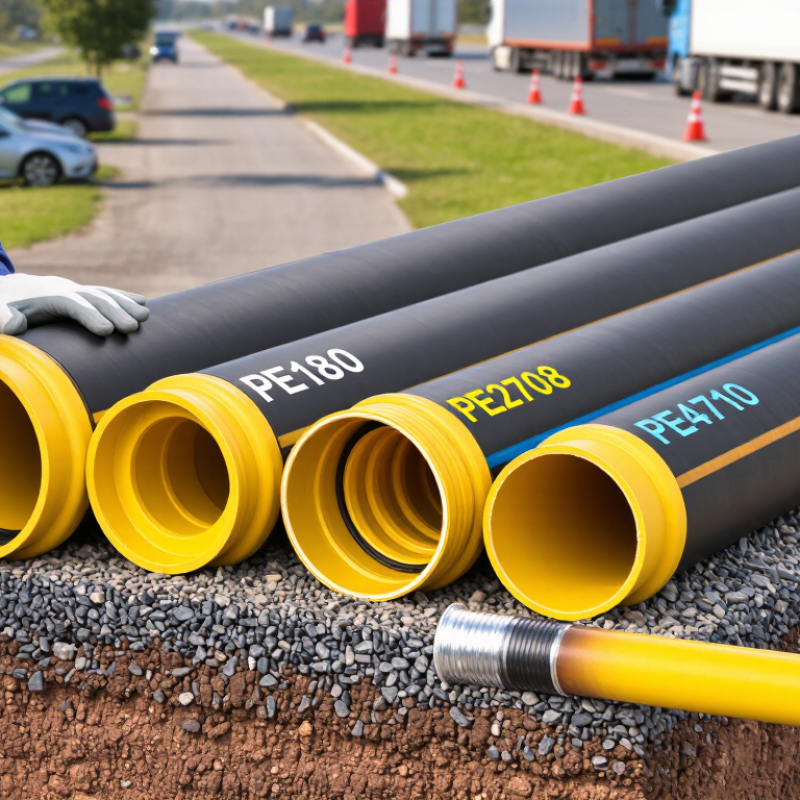
What Are PE Gas Pipes?
Polyethylene (PE) gas pipes are flexible plastic pipes designed to carry natural gas and other approved fuel gases. They are manufactured from high-density polyethylene and joined by heat fusion, creating a continuous, leak-resistant system. Unlike metal pipes, PE does not rust, and its flexibility helps it follow curved underground routes with fewer fittings.
The U.S. Pipeline and Hazardous Materials Safety Administration reported more than 1.3 million miles of gas distribution mains in 2023. A large share uses plastic pipe, especially PE, because it reduces corrosion risks and installation labor. The Plastics Pipe Institute states that properly designed PE systems can provide a service life exceeding 50 years. That figure depends on soil conditions, pressure, fusion quality, and inspection. It is not a promise for every project.
PE gas pipe types often include PE2708 and PE4710 materials, classified under ASTM D2513. PE4710 generally offers higher pressure capability and improved resistance to slow crack growth, according to industry design guidance. Still, “best” is not universal. Lower-pressure residential networks may need a different size or pressure class than urban mains. Engineers should check operating pressure, temperature, wall thickness, burial depth, and local codes before selection. Small installation errors matter. Poorly prepared fusion surfaces can undermine an otherwise excellent pipe.
How PE Gas Pipes Are Manufactured and Classified
PE gas pipes are manufactured from polyethylene resin selected for strength, flexibility, and resistance to soil chemicals. The resin arrives as small, uniform pellets. Manufacturers blend it with approved carbon black and stabilizers, when required, to improve protection against sunlight and heat.
The mixture enters an extruder, where controlled heat melts it into a continuous tube. A forming die sets the diameter and wall shape. Vacuum sizing keeps the dimensions stable, while water cooling hardens the pipe. Operators then inspect the surface, measure the wall thickness, and test samples for pressure resistance, elongation, and slow crack growth. Small production changes can matter. Temperature drift, moisture, or poor pellet mixing may weaken long-term performance.
Classification usually considers material grade, outside diameter, wall thickness, and pressure capability. PE80 and PE100 describe different minimum required strength levels. PE100 generally supports higher operating pressures with comparable dimensions, but the design still depends on the SDR value. SDR compares pipe diameter with wall thickness; a lower SDR usually means a thicker wall. Pipes may also carry markings for gas service, production batch, size, material grade, and applicable standards such as ISO 4437 or regional equivalents. These markings support traceability, not automatic approval. Requirements vary between countries and utilities, so engineers must verify the permitted material, joining method, and pressure rating before installation. No classification system is perfect. Field conditions still deserve careful judgment.
Key Properties and Advantages of PE Gas Pipes
PE gas pipes are made from polyethylene, a tough thermoplastic used in buried gas distribution networks. Their key advantage is resistance to soil corrosion: unlike metal, PE does not rust when exposed to damp ground. It is also flexible, so it can accommodate modest ground movement and bends with fewer joints. Fewer joints can mean fewer potential leak points, but installation quality still matters. The Plastics Pipe Institute’s Handbook of PE Pipe discusses these performance characteristics and the need for proper design and handling.
Material grades matter. Under ISO 9080 and ISO 12162 classification, PE80 has a minimum required strength (MRS) of 8 MPa, while PE100 is rated at 10 MPa. These figures describe long-term material strength under specified test conditions; they do not alone determine a pipe’s safe operating pressure. Wall thickness, diameter, temperature, gas type, and local engineering requirements also affect selection. PE100 can support higher design stress for a given dimension, but it is not automatically the best choice for every project.
Tips: Check the pipe’s certification, pressure rating, and compatibility with the network design. Protect it from sharp stones during trench backfilling. A small oversight here can undo a strong material choice. Proper jointing and qualified installation are essential, and inspection records should be retained.
Main Types of PE Gas Pipes and Their Applications
Main Types of PE Gas Pipes and Their Applications
Polyethylene (PE) gas pipes are flexible, corrosion-resistant pipes used to carry fuel gas in approved distribution systems. Common types include PE 80 and PE 100, classifications that indicate material performance under specified conditions. PE 100 generally allows higher pressure capacity for a comparable pipe size, while PE 80 may suit some lower-pressure applications. The right choice depends on system design, operating pressure, soil conditions, and applicable requirements.
PE gas pipes are used in buried mains, service connections, and distribution networks. Larger-diameter pipes can carry gas along streets, while smaller service pipes connect a main to a building’s meter area. Yellow or otherwise clearly marked pipe helps crews identify gas lines during installation and maintenance. Still, color alone is not proof of suitability. Specifications, markings, fittings, and installation methods all need careful checking. Pipe selection can feel straightforward on paper, but site conditions often complicate it.
Tips: Confirm the pipe’s pressure rating and intended gas application before installation. Use compatible fittings, protect pipes from sharp stones, and follow local codes and the project design. Have qualified professionals install and inspect the system. A small oversight matters.
How to Choose the Best PE Gas Pipe for Your Project
Choosing a PE gas pipe starts with the project conditions, not the material label. Check the required operating pressure, gas type, ground temperature, burial depth, and installation method. Then confirm the pipe’s dimensions and SDR: a lower SDR means a thicker wall for the same outside diameter. The Plastics Pipe Institute’s Handbook of Polyethylene Pipe explains how pressure capacity depends on material properties, wall thickness, and temperature. ISO 4437 also sets requirements for polyethylene piping systems used in gas supply. Small details matter. A rocky trench, tight bend, or poorly matched fitting can undermine an otherwise suitable pipe.
For material selection, compare documented performance rather than relying on a generic “PE” description. ISO 12162 classifies PE100 with a minimum required strength of 10 MPa at 20°C, based on long-term hydrostatic testing. That figure is not a project pressure rating; design factors, temperature, dimensions, and applicable specifications still govern. Ask suppliers for traceable test documentation and verify compatibility with the joining method and fittings. Inspect the route, too. A drawing rarely shows every sharp stone. The best choice is the pipe that meets the design conditions and can be installed and inspected consistently. I would still review the assumptions with a qualified gas-piping engineer before ordering.
