Global buyers are paying closer attention to Screen Door Parts as renovation and housing maintenance markets continue expanding. The U.S. Census Bureau’s Construction Spending reports show sustained activity in residential improvements and repairs. Harvard Joint Center for Housing Studies also identifies aging homes as a continuing driver of replacement demand. These trends create opportunities, but they also expose weak sourcing decisions. A door may look simple. Its performance depends on rollers, tracks, mesh, handles, hinges, springs, and frame tolerances working together.
Small details matter. Experienced buyers should examine material grades, corrosion resistance, load capacity, packaging, and installation compatibility. Aluminum frames suit many humid environments, while stainless steel hardware can offer stronger resistance in coastal conditions. However, “stainless steel” is not always enough information. Buyers should request the exact grade, test method, and supporting documents. ISO 9227 salt-spray testing and EN 1670 corrosion classifications can help compare hardware performance, although neither replaces local field experience. The U.S. National Association of Home Builders and Freedonia industry research also show how repair activity responds to housing age, weather exposure, and consumer maintenance choices. Their findings support a practical conclusion: replacement parts require more than a low unit price.
Fit comes first. Global buyers should confirm dimensions, mesh specifications, screw patterns, carton protection, and quality-control procedures before ordering. Supplier audits, sample testing, and clear tolerances reduce avoidable claims. Even careful procurement has limits. Climate, installation skill, and user habits can change real-world results. That uncertainty deserves honest discussion, not polished promises.
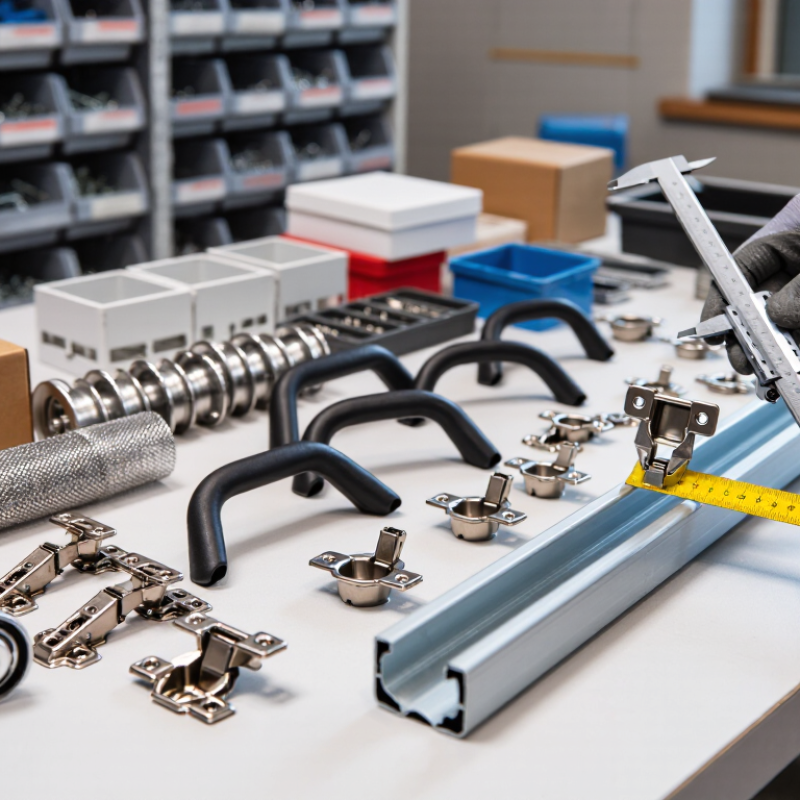
Screen door parts work together to improve airflow, security, and daily comfort. The mesh blocks insects while allowing light and air through. The frame supports the panel and keeps the mesh tight. Hinges guide hinged doors, while rollers help sliding doors move smoothly along a track. Handles and latches control access. A door closer can prevent sudden slamming. Spline, corner keys, and replacement seals secure the mesh and reduce gaps.
Common types include hinged, sliding, retractable, and magnetic screen doors. Each design needs different hardware and measurements. In my experience, buyers often focus on the mesh but overlook rollers, tracks, or latch alignment. That mistake can cause noise, sticking, or early wear. Material choice also matters. Aluminum suits many outdoor settings, while stainless steel hardware can better resist moisture. Fiberglass mesh is flexible, but it may not withstand heavy contact as well as stronger mesh. No part is perfect.
Tips: Measure the opening, frame thickness, hole spacing, and track width before ordering. Check whether the replacement part matches the door type. Ask for drawings, material details, and sample dimensions. For global shipments, confirm packaging quality and corrosion protection. A small mismatch can stop installation. Also, review local safety requirements. Even careful measurements can be wrong, so compare them with the existing part before final approval.
Screen doors typically include a frame, mesh, spline, rollers or hinges, a latch, and sometimes a closer. Mesh selection is commonly specified by the number of openings per linear inch in the horizontal and vertical directions.
How to read the chart: Higher mesh counts generally create smaller openings, which can improve insect protection while reducing airflow slightly. Actual performance also depends on mesh material, wire diameter, frame design, spline fit, and hardware quality.
Choosing screen door parts starts with the frame, not the mesh. Aluminum frames suit humid areas because they resist swelling and corrosion. Fiberglass frames cost less, but they may flex under repeated use. Measure the opening at three points. Use the smallest width and height. This simple habit prevents binding. The U.S. Department of Energy estimates that windows can cause 25–30% of household heating and cooling energy loss. A straight frame and tight seal support better ventilation control.
Mesh selection depends on exposure, insects, and maintenance. Fiberglass mesh offers affordable visibility and easy replacement. Stainless steel mesh provides stronger resistance against pets, impact, and coastal air. Smaller openings improve insect protection, but they can reduce airflow and collect dust. The World Health Organization recorded about 263 million malaria cases worldwide in 2023. This figure does not make every screen door a medical product, but it shows why buyers should treat mesh quality seriously. Confirm wire diameter, opening size, coating, and tear resistance with test documents.
Tips: Choose tracks with drainage paths and replaceable rollers. Tracks collect grit quickly. Check wheel adjustment before approving a shipment. Fittings should match frame thickness, screw type, and expected cycle count. ASTM or ISO test references improve supplier comparisons. Still, laboratory results may not reflect salty air, uneven walls, or careless installation. Request samples and test them through repeated opening, closing, and cleaning. A small design compromise can become a costly field complaint.
Global buyers should treat screen door materials as performance decisions, not simple appearance choices. Aluminum frames resist rust and remain lightweight, while stainless steel offers stronger protection in demanding environments. Fiberglass mesh is flexible and affordable, but its coating must tolerate sunlight, moisture, and repeated cleaning. In coastal areas, even small amounts of salt can expose weak finishes. Do not judge quality by color alone.
Frame thickness, corner strength, and mesh tension deserve close inspection. A reliable supplier should provide material specifications, dimensional tolerances, and test records. Useful checks may include corrosion resistance, UV exposure, impact strength, and repeated opening tests. Standards differ between markets, so buyers should confirm whether testing follows suitable regional or international methods. A certificate without traceable test details proves little. Ask for batch numbers, inspection dates, and sample conditions.
Small defects can reveal larger problems. A slightly uneven coating may not affect performance, but a loose corner often becomes worse after shipping. I have seen attractive samples fail because the production mesh was thinner. That gap between sample and shipment remains a common risk. Buyers should inspect pilot orders, not only photographs. Packaging also matters; crushed frame edges can create installation failures before the door reaches the job site. Clear acceptance criteria, independent inspection, and written material records make quality easier to verify across borders.
| Screen Door Part | Common Materials | Typical Dimensions or Specifications | Key Quality Indicators | Relevant Test Methods or Standards | Global Buyer Considerations |
|---|---|---|---|---|---|
| Screen Mesh | Fiberglass-coated PVC, aluminum, stainless steel, or polyester | Common insect-screen configurations include 18 × 16 mesh and 20 × 20 mesh; mesh count means openings per linear inch | Uniform openings, consistent wire or yarn diameter, tear resistance, UV stability, and clean coating | ASTM D882 may be used for tensile properties of plastic-film materials; ASTM G154 may be used for accelerated UV exposure testing where applicable | Specify mesh count, finished roll width, color, openness factor, and intended insect or ventilation requirement. Do not compare mesh count alone without checking wire or yarn diameter |
| Door Frame or Sash Profile | Aluminum alloy, galvanized steel, reinforced PVC, or wood | Common aluminum profile wall thicknesses are approximately 0.8–1.5 mm, depending on the door size and design | Straightness, accurate corner geometry, adequate wall thickness, smooth finish, and resistance to twisting | ASTM B117 or ISO 9227 can be used for comparative neutral salt-spray testing of metallic finishes; acceptance limits should be agreed in advance | Confirm alloy, temper, profile dimensions, corner-joining method, coating type, and tolerances. Larger doors generally require stronger profiles or intermediate reinforcement |
| Screen Spline | EPDM rubber, flexible PVC, or thermoplastic elastomer | Common nominal diameters include approximately 0.120 in, 0.125 in, and 0.140 in; the correct size depends on the frame groove and mesh thickness | Stable diameter, flexibility across the expected temperature range, resistance to cracking, and secure retention in the groove | Material testing may include tensile, elongation, hardness, and low-temperature flexibility tests specified by the purchasing agreement | Request the groove width and depth, spline diameter tolerance, cross-section sample, and compatibility with the selected mesh. Oversized spline can distort the frame |
| Roller Assembly | Nylon, acetal, steel, stainless steel, zinc alloy, or aluminum | Common sliding-door roller diameters are approximately 19–32 mm; axle, housing, and adjustment dimensions vary by system | Smooth rotation, low noise, adequate load capacity, corrosion resistance, and reliable height adjustment | Cycle testing, load testing, and corrosion testing should be defined according to the door weight and operating environment | Provide door weight, track profile, wheel diameter, wheel material, bearing type, housing dimensions, and adjustment range. A dimensional sample is strongly recommended |
| Hinges | Stainless steel, steel with protective coating, aluminum, or reinforced polymer | Typical butt-hinge leaves range from approximately 50–100 mm in height; thickness and screw pattern depend on door mass | Accurate knuckle alignment, secure pin retention, consistent opening torque, and resistance to sagging | ASTM B117 or ISO 9227 may be used to compare corrosion resistance of metallic finishes; hinge-cycle requirements should be project-specific | Match the hinge count and load rating to the door size and weight. Verify screw-hole spacing, pin diameter, handedness, and compatibility with the frame |
| Handle and Latch | Zinc alloy, aluminum, stainless steel, steel, nylon, or acetal components | Common lever or pull-handle center-to-center dimensions range from approximately 64–96 mm, but installation patterns vary widely | Positive latching, smooth operation, secure fastening, wear resistance, and resistance to outdoor corrosion | ASTM D3359 can be used to evaluate coating adhesion on coated metal surfaces; operational cycle and pull-force limits should be specified by the buyer | Confirm backset, mounting-hole spacing, spindle or latch dimensions, handing, key or non-key operation, and compatibility with the strike plate |
| Door Closer or Spring | Steel, stainless steel, aluminum, or reinforced polymer | Spring force and closer size should be selected according to door width, door weight, wind exposure, and closing speed requirements | Controlled closing, consistent spring force, smooth adjustment, secure mounting, and resistance to leakage or fatigue | Cycle testing and temperature-condition testing should be completed using the intended door size and operating load | Specify opening angle, closing time, hold-open requirement, adjustable force, temperature range, and whether the product is intended for exterior exposure |
| Weatherstripping or Brush Seal | EPDM, silicone, PVC, polypropylene, nylon, or thermoplastic elastomer | Common brush pile heights range from approximately 5–15 mm; compression seals are selected by gap size and compression ratio | Continuous coverage, uniform pile or profile, strong backing, low compression set, and resistance to sunlight and moisture | ASTM D395 may be used for compression-set testing of elastomers; ASTM G154 may be used for comparative UV exposure testing where applicable | Measure the actual clearance around the door. Specify backing width, pile height, adhesive or fixing method, temperature range, and replacement availability |
| Corner Keys and Joining Components | Nylon, glass-fiber-reinforced polymer, zinc alloy, or aluminum | Dimensions must match the internal profile cavity; common designs use insert-fit or screw-fixed corner joints | Accurate fit, adequate impact strength, minimal joint movement, and consistent geometry across production batches | Dimensional inspection, impact testing, and assembly pull-out testing can be specified for quality control | Request profile drawings, insertion depth, corner angle, screw specification, and assembled-frame samples. Poor corner fit can cause mesh loosening and door sag |
| Track, Threshold, or Bottom Guide | Aluminum, stainless steel, galvanized steel, nylon, or acetal | Track width and guide height depend on the roller or door system; low-profile thresholds are commonly selected for easier access | Straight running surface, accurate alignment, drainage capability, wear resistance, and compatibility with the rollers | Dimensional inspection, load testing, cycle testing, and corrosion testing may be applied according to the installation environment | Confirm track width, guide height, drainage design, surface finish, replacement method, and compatibility with local installation conditions |
| Fasteners | Stainless steel, zinc-plated steel, coated steel, or aluminum | Common screw sizes are selected by frame thickness and substrate; exterior applications generally require corrosion-resistant fasteners | Correct thread form, consistent head dimensions, adequate torque performance, and resistance to galvanic corrosion | ISO 3506 applies to certain stainless-steel fastener mechanical properties; coating and corrosion requirements should be stated separately | Identify metric or inch threads, head style, drive type, material grade, coating, packaging quantity, and compatibility with the frame material |
Note: Dimensions and specifications shown are common market references rather than universal requirements. Buyers should confirm final tolerances, performance targets, climate exposure, applicable building codes, and regional safety regulations with the project specification and test samples.
Screen door parts are rarely universal, even when they look similar. Global buyers should measure the opening at the top, middle, and bottom. Record the smallest width and height, then compare them with the supplier’s tolerance range. Measure in millimeters and inches when international teams are involved. A two-millimeter difference can affect the fit.
Compatibility depends on more than size. Check the frame profile, roller diameter, corner shape, spline groove, latch position, and track depth. Take clear photos beside a ruler. This helps suppliers identify hidden differences. A common mistake is matching only the visible mesh panel. The replacement roller may still fail because its stem length is wrong.
Installation requires a stable frame, clean tracks, suitable fasteners, and enough clearance for adjustment. Remove dust and old sealant before fitting new parts. Test the door several times before tightening every screw. In coastal areas, select materials suited to salt exposure and humidity. Local safety and building requirements may also affect fastener placement or door operation. Even experienced installers sometimes skip the final alignment check. That shortcut can cause rubbing, gaps, or early wear. Allow buyers to confirm metric standards, packaging protection, spare parts, and installation instructions before placing a large order.
Sourcing starts with a clear parts list. Common items include rollers, tracks, corner keys, handles, latches, and mesh panels. The World Bank’s 2023 Logistics Performance Index covered 139 economies. Its findings show that shipment reliability remains uneven across markets. Buyers should confirm dimensions, alloy grades, surface finishes, and replacement compatibility before ordering. Ask suppliers for drawings, sample approvals, and batch records. Small differences can stop installation.
Inspection should test more than appearance. Check roller movement, latch strength, spring recovery, and mesh tension. For metal parts, verify coating thickness and corrosion resistance through documented testing. Packaging needs equal attention. UNCTAD’s Review of Maritime Transport 2024 reported that maritime trade grew by 2.4% in 2023, increasing pressure on international handling networks. Use separators, moisture barriers, corner protection, and carton drop testing. I have seen clean parts arrive with bent tracks. Packaging was the weak point.
Tips: Request a pre-shipment inspection with photos and measurements. Print the part code on every inner bag. Keep ten percent of fast-moving spare parts locally when possible. After-sales support should include installation guidance, defect evidence rules, and response targets. A replacement policy sounds useful, but unclear freight responsibility creates disputes. Buyers should record recurring failures, even when the supplier seems reliable. That uncomfortable review often reveals a design problem, not only a production error.