What Is a Twin Shaft Concrete Mixer?

Concrete production rarely fails because of one dramatic mistake. More often, uneven moisture, poor timing, or overloaded equipment quietly reduces quality. This is where a twin shaft concrete mixer deserves closer attention. It uses two counter-rotating shafts and overlapping paddles to create intensive, three-dimensional mixing. The result can be a more consistent blend of cement, aggregates, water, and admixtures than many conventional systems. The phrase “Twin Shaft Mixer Concrete” usually describes concrete produced with this equipment, rather than a separate concrete material.

Industry data explains why mixing performance matters. The Global Cement and Concrete Association reports that the world uses roughly 14 billion cubic metres of concrete each year. The American Concrete Institute’s ACI 304R guide also stresses controlled batching, mixing, transportation, and discharge practices. ASTM C94/C94M provides requirements for ready-mixed concrete, including uniformity and delivery controls. These standards do not declare one mixer design universally superior. They offer a better lesson: equipment must support measurable quality control.

In practical operation, operators watch the mixer current, batch moisture, cycle time, and discharge texture. A well-adjusted machine should produce a cohesive mix without dry pockets around the paddles. Small details matter. Overfilling can reduce movement. Excessive water can damage strength. Poor maintenance can create uneven wear and inconsistent results. Twin shaft mixers are powerful, but not magical. Their performance still depends on accurate recipes, trained operators, suitable liners, and regular inspection. Any article about this technology should acknowledge that limitation, because reliable concrete begins with disciplined process control, not machinery alone.
What Is a Twin Shaft Concrete Mixer?

Definition and Basic Structure of a Twin Shaft Concrete Mixer

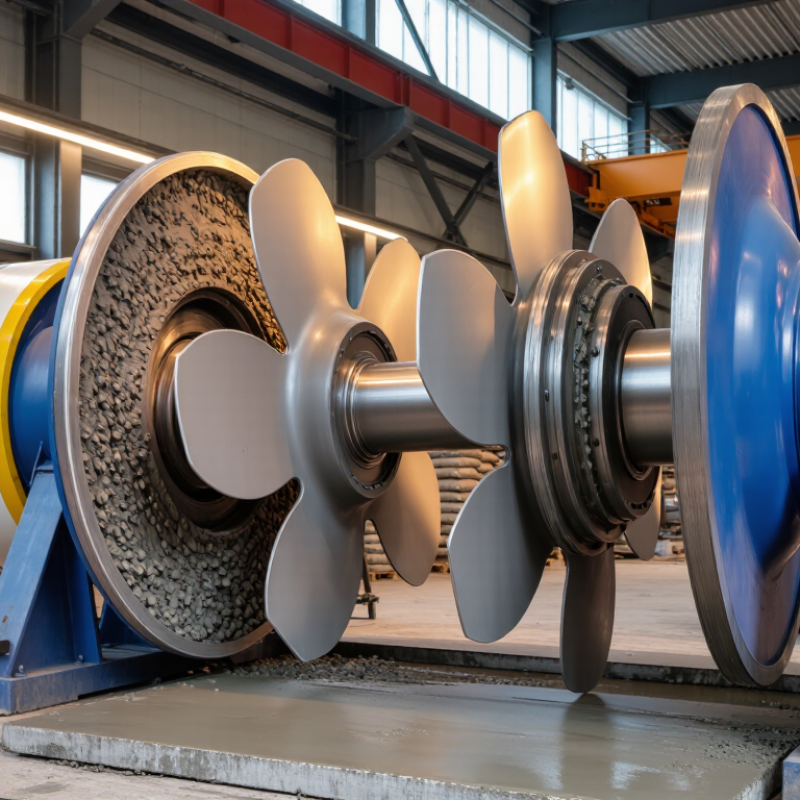
A twin shaft concrete mixer is an industrial machine designed to blend cement, aggregates, water, and chemical admixtures quickly and evenly. Its basic structure contains two horizontal shafts inside a reinforced mixing chamber. Each shaft carries several mixing paddles or arms. The shafts rotate toward each other, lifting material from the bottom and pushing it through the central zone.

This counter-rotating action creates strong convection and controlled shearing. Dry gravel moves upward, while wetter cement paste spreads across the aggregate surface. A discharge gate usually sits beneath the chamber. Hydraulic or electric actuators open it after mixing. Scrapers, end plates, bearings, seals, and a drive system complete the main structure. The Global Cement and Concrete Association estimates that more than 30 billion tonnes of concrete are used globally each year, so reliable mixing remains a practical production concern.

In field operation, operators often inspect paddle wear, shaft seals, and moisture readings before production. A worn paddle can leave pale, unmixed pockets near the chamber wall. That detail is easy to miss. ASTM C94/C94M emphasizes consistent batching and uniform concrete delivery, but the mixer alone cannot guarantee quality. According to the International Energy Agency’s 2024 cement sector analysis, cement production creates roughly 2.5 gigatonnes of direct CO2 emissions annually. Better mixing may reduce rejected batches and material waste, although actual savings depend on moisture control, loading sequence, and maintenance discipline. The structure is powerful, not magical.

How Twin Shafts and Mixing Paddles Work Together

What Is a Twin Shaft Concrete Mixer?

A twin shaft concrete mixer uses two parallel horizontal shafts inside a fixed mixing chamber. Each shaft carries several mixing paddles. As the shafts rotate in opposite directions, the paddles lift, split, and fold the batch through the center. This movement creates strong circulation rather than a simple turning motion. That difference matters.

Mixing paddles do the practical work inside the chamber. One paddle catches material from the lower area and pushes it upward. The neighboring shaft receives that flow and redirects it across the batch. Together, they create overlapping mixing paths that reach most areas quickly. Dry cement, damp sand, stone, and water repeatedly change position. Paddle angle, shaft speed, and clearance affect the final uniformity. Too much material can reduce circulation. Too little material may increase wear without improving output.

In field inspections, operators often check paddle edges, shaft seals, and buildup around the chamber. Worn paddle tips can leave unmixed pockets near the walls. Hardened concrete can also change the intended clearance. That detail is easy to miss. No mixer removes every variable. Aggregate shape, moisture, and loading order still affect performance. I have seen a well-designed mixer perform poorly when the batch was overloaded or water entered too quickly. Careful loading and regular inspection remain necessary.

What Is a Twin Shaft Concrete Mixer? - How Twin Shafts and Mixing Paddles Work Together

Data Dimension Typical Information How It Relates to Mixing Performance
Mixer Type Horizontal twin-shaft forced-action concrete mixer Two counter-rotating shafts actively move the materials instead of relying mainly on gravity.
Main Mixing Principle Convection, shearing, lifting, folding, and cross-mixing These combined actions distribute cement paste, water, aggregates, and admixtures throughout the batch.
Number of Shafts Two parallel horizontal shafts The shafts create two interacting mixing zones and improve material circulation across the chamber.
Shaft Rotation Counter-rotation; the exact direction depends on the mixer design Opposing movement helps generate turbulence and transfers material between the two shafts.
Mixing Paddles Wear-resistant paddles mounted around each shaft Paddles lift, push, split, and fold the mixture while maintaining continuous contact with the batch.
Paddle Arrangement Helical or staggered arrangement with adjustable overlap and angle The arrangement controls axial movement, mixing intensity, and the time required to reach uniformity.
Typical Effective Fill Level Approximately 50%–70% of the effective mixing volume, depending on the material and design Correct filling allows the paddles to circulate the batch without excessive dead zones or overload.
Common Nominal Batch Sizes Approximately 0.5–6.0 m³ per batch for common construction applications The required size depends on plant output, concrete type, cycle time, and available installation space.
Typical Mixing Time About 30–90 seconds after all major ingredients enter the chamber Actual time varies with moisture, aggregate grading, recipe complexity, batch size, and discharge requirements.
Typical Rotor Speed Commonly about 15–35 revolutions per minute Lower speeds handle dense concrete efficiently, while the selected speed must limit splashing, segregation, and wear.
Material Compatibility Normal concrete, high-strength concrete, dry concrete, mortars, and many low-slump mixes Forced mixing is useful when the mix contains coarse aggregates, limited water, fibers, or supplementary cementitious materials.
Aggregate Size Often suitable for aggregate sizes up to approximately 40–80 mm, subject to mixer design The permitted maximum size is determined by paddle clearance, chamber geometry, and the manufacturer’s engineering limits.
Paddle-to-Liner Clearance Usually kept small and checked during maintenance; the exact value is design-specific Proper clearance promotes effective scraping and mixing while preventing contact between rotating paddles and liners.
Mixing Chamber Horizontal trough with replaceable wear liners The chamber contains the material, while replaceable liners protect the shell from abrasive aggregates and cement paste.
Drive System Electric motors, reduction gearboxes, couplings, and synchronized shaft transmission The drive must deliver high torque at low speed and keep both shafts synchronized under changing loads.
Discharge Method Hydraulic, pneumatic, or mechanically actuated bottom discharge gate A wide discharge opening helps empty the chamber quickly and reduces leftover concrete between batches.
Uniformity Indicator Consistent color, moisture distribution, aggregate dispersion, and slump throughout the batch Uniformity should be verified through production testing rather than judged only by mixing time.
Key Advantages Fast mixing, strong homogenization, good low-slump performance, and efficient fiber dispersion The interaction between the two shafts and paddles exposes more material to active mixing forces.
Main Maintenance Points Paddles, liners, shaft seals, bearings, gearboxes, discharge gates, and lubrication points Routine inspection helps maintain mixing quality, prevent leakage, and reduce unplanned downtime.

Note: Performance ranges are typical engineering references. Actual values depend on mixer geometry, concrete formulation, aggregate characteristics, operating conditions, and maintenance status.

Key Components and Operating Process

What Is a Twin Shaft Concrete Mixer?

Key Components and Operating Process

A twin shaft concrete mixer uses two parallel shafts inside a heavy mixing chamber. Each shaft carries overlapping paddles that rotate in opposite directions. This movement lifts, folds, and pushes concrete across the chamber. The main components include the mixing trough, shafts, paddles, drive motors, gearboxes, seals, and discharge gate. A water system and control panel manage the batch with measured timing.

The operating process begins with a routine inspection. Operators check paddle wear, shaft seals, gate movement, and lubricant levels. Dry aggregate and cement usually enter before water and admixtures. As the shafts turn, the paddles create strong cross-mixing rather than simple circular motion. This helps coat aggregate surfaces and distribute cement paste more evenly. Mixing time depends on the recipe, moisture, temperature, and required consistency. More time is not always better.

The discharge gate opens after the batch reaches its target condition. A clean, fast release reduces leftover material inside the chamber. In practice, timing is rarely perfect. Moist sand can change the batch quickly. A small oversight matters.

Experienced operators watch motor load, sound, and material flow while checking sample consistency. These observations support reliable production, although visual judgment should not replace tested mix procedures. Paddle alignment and liner condition also deserve regular attention. I have found that neglected wear often appears as uneven mixing before it becomes an obvious mechanical fault.

Main Advantages Over Other Concrete Mixer Types

What Is a Twin Shaft Concrete Mixer?

Main Advantages Over Other Concrete Mixer Types

A twin shaft concrete mixer uses two horizontal shafts fitted with mixing paddles. The shafts rotate inward, creating strong circulation across the mixing chamber. Materials move through several zones instead of staying in one slow-moving mass. This design helps produce a more uniform blend of cement, aggregates, water, and additives.

Its main advantage is speed. Compared with many drum mixers, a twin shaft unit can mix stiff, low-slump concrete more aggressively. It also handles large aggregate particles and demanding industrial recipes with less dead material around the chamber. The overlapping paddle action improves discharge consistency, which matters when each truck load must meet the same specification. Operators often notice shorter mixing cycles and fewer dry pockets.

It is not perfect. The paddles and liners face heavy abrasion, especially with sharp stone or recycled aggregate. Regular inspection is essential. A worn paddle can quietly reduce mixing quality before the problem becomes obvious. Twin shaft mixers also require accurate weighing and moisture control; better mechanical action cannot correct poor batching. In my experience, cleaning access is another practical concern. A mixer that performs well but takes too long to clean may slow the entire production line. Drum mixers remain useful for simpler, smaller jobs where lower maintenance matters more than maximum output.

Common Applications and Selection Considerations

What Is a Twin Shaft Concrete Mixer?

Common Applications and Selection Considerations

A twin shaft concrete mixer uses two counter-rotating shafts with overlapping paddles. This action creates strong convection and shortens mixing time. It suits ready-mix plants, precast yards, dry-cast production, and large infrastructure projects. The Global Cement and Concrete Association estimates that about 30 billion tonnes of concrete are produced globally each year. That scale increases demand for consistent, high-throughput mixing equipment.

Moisture changes everything. For stiff concrete, interlocking pavers, or roller-compacted concrete, select a mixer with high torque and adjustable paddle positioning. For conventional ready-mix, discharge speed and batch uniformity may matter more. The USGS Mineral Commodity Summaries 2024 reported approximately 4.1 billion metric tonnes of global cement production in 2023. This figure reflects continuing material demand, but it does not guarantee that one mixer design fits every plant.

Check aggregate size, batch volume, cycle time, and cleaning access before purchase. Large stones can increase wear around the paddles and liners. Abrasion-resistant components may reduce replacement frequency, although they usually raise the initial cost. A reliable selection also considers water dosing accuracy, dust control, inspection space, and local technician support. Small details matter. Operators often focus on rated capacity and overlook actual filling levels. That is a mistake I have seen in practice. A mixer running below its effective load can waste energy and deliver less consistent concrete. Data from the equipment trial should guide the final decision, not a brochure alone.

What Is a Twin Shaft Concrete Mixer?

Twin-shaft concrete mixers use two synchronized horizontal shafts with overlapping mixing paddles to produce fast, uniform blending. They are commonly selected for precast concrete, ready-mix production, roller-compacted concrete, and mass-concrete work.

The chart shows indicative nominal batch-capacity ranges commonly used for different applications. Smaller capacities generally suit controlled precast production, while larger capacities are more suitable for ready-mix, roller-compacted concrete, and mass-concrete operations. Final selection should also consider aggregate size, moisture variation, required cycle time, mix consistency, installation space, and maintenance access.